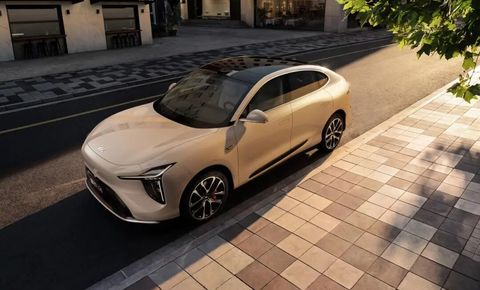
Back in 2024, steer-by-wire technology first appeared in mass-produced vehicles; the industry consensus at the time was that while it was a great feature, it was out of reach for the average consumer.
On July 1, 2026, the national standard for steer-by-wire systems—Basic Requirements for Automotive Steering Systems (GB17675-2025)—officially came into effect. Spearheaded by SAIC Motor, this move effectively opened the regulatory floodgates.
On September 16, 2026, the Li Auto i9 launched, featuring steer-by-wire and rear-wheel steering as standard equipment. Li Xiang specifically discussed these features on Weibo, noting that achieving both spaciousness and excellent handling requires technological advancement rather than simply making vehicles larger. Steer-by-wire and rear-wheel steering represent the specific areas where Li Auto is investing to enhance the user experience.
It is evident, then, that the widespread adoption of steer-by-wire chassis technology is becoming an industry consensus.
On September 23, the all-new IM LS6 launched with a starting price of 197,900 RMB. It comes standard across the entire lineup with a full steer-by-wire chassis, racking up over 11,000 new orders within just 57 minutes of its release.
If you don’t buy a car with a steer-by-wire chassis now, you are bound to regret it in three years.
In less than two years, the technology has undergone a rapid evolution: moving from being unaffordable to accessible, and finally to becoming a feature one risks falling behind without. While many still view it as a rare luxury reserved for flagship models, IM has brought it down to the 200,000 RMB price point.
A product manager described the current status of steer-by-wire chassis technology to Leiphone.com this way: buying a car without a steer-by-wire chassis today is akin to buying a car without full-vehicle OTA capabilities in 2020, without LiDAR in 2022, with a 400V architecture in 2023, or without a digital chassis in 2025. At the time, these features might have seemed “good enough,” but three years later, buyers would inevitably regret their choice. If you don’t buy a car with a steer-by-wire chassis now, you’re bound to regret it in three years.
01
Why you’ll regret not buying one now
Steer-by-wire technology eliminates the steering column that physically “welds” the steering wheel to the wheels.
In traditional mechanical steering, there is a rigid connection between the steering wheel and the wheels. During human-machine co-driving, if the system attempts to steer, it fights against the driver’s hands—a phenomenon often criticized as the system “wrestling” for control of the wheel. However, L3-level autonomy and above require the driver to take their hands off the wheel, making the mechanical connection a hindrance. By removing the column and converting steering inputs into electrical signals, steer-by-wire enables intelligent driving systems to truly take full control and implement complete redundancy.
This is precisely why you will regret not buying one: OTA updates can modify software, but steer-by-wire changes the hardware itself.
If you buy a car without steer-by-wire today, no amount of software upgrades three years down the line will allow the physical controls to keep pace with the system’s “brain.” This represents a hardware limitation that cannot be retrofitted later; unlike a laggy infotainment system that can be fixed with an update, the chassis’s fundamental capabilities are set in stone the moment you take delivery.
This view isn’t unique to IM Motors. From NIO developing its own chassis domain controllers and Li Auto emphasizing steer-by-wire and rear-wheel steering in its 400,000-yuan flagship models, to Huawei treating the chassis as a physical interface programmable by algorithms, the chassis is evolving from an off-the-shelf “black box” into a capability defined by the automaker itself.
If you don’t buy a car with a steer-by-wire chassis now, you’re bound to regret it in three years.
Undoubtedly, steer-by-wire represents an industry consensus; the only point of disagreement lies in the price point at which this technology will become standard.
Over the past two decades, the automotive industry has seen the emergence of features that initially seemed optional but later proved to be watershed moments—ABS, ESP, and vehicle-wide OTA updates are prime examples. Steer-by-wire chassis technology is the next such milestone.
When considering whether a technology is worth prioritizing during a car purchase, the ultimate question to answer is: what is its actual value to the user? The value of a steer-by-wire chassis can be explored through three questions: Can the vehicle control its posture more promptly and cohesively when facing sudden emergencies? As intelligent driving evolves, can the chassis provide the necessary execution capabilities? And regarding daily commutes and school runs, can a large vehicle be driven with greater ease and better handling?
Safety, intelligent driving, and daily handling correspond to critical moments, the future, and everyday use, respectively. Together, they determine whether this technology warrants a place on a car buyer’s shortlist today.
IM Motors’ validation of the first question began with a test designed to become progressively more difficult.
Internally, IM Motors dubbed this series of tests the “Five-Part Safety Challenge.”
Initially, they designed only two challenges: a crash test using a vehicle similar in size to the LS6—standard practice in R&D—and a test on a wet, slippery surface. The team found these two tasks easy to handle. Wei Pengda, head of the High-Performance Sports Division, consulted with R&D engineers about increasing the difficulty. Consequently, the number of challenges grew from two to three, then four, and finally five.
By the time they reached the fifth challenge, the chassis director was under immense pressure, fearing Wei might add a sixth.
Ultimately, the challenge unfolded within a test zone spanning just over 20 meters, featuring simultaneous crosswinds from six large fans and a torrential downpour. The vehicle was first struck by a truck—suffering a diagonal tire blowout at the moment of impact—and immediately afterward, a large obstacle box suddenly dropped into its path.
Five distinct hazards occurred almost simultaneously, yet the vehicle did not spin out of its lane; instead, it stabilized its body and came to a safe stop.
Xu Yin, Deputy General Manager of IM Motors, made a point of emphasizing that the video was not AI-generated but actual footage of a real vehicle.
Why push a vehicle to such extremes?
For the past two decades, discussions on automotive safety have focused largely on structural rigidity, the number of airbags, and crash-test star ratings. However, in real-world accidents, danger often arises much earlier; once a vehicle loses control following a tire blowout, crosswind, or initial impact, subsequent collisions become difficult to avoid. What steer-by-wire chassis technology aims to address is that critical window of a few seconds before a vehicle loses control.
This approach bears a resemblance to fly-by-wire systems in aviation: when danger arises suddenly, the system intervenes faster than human reflexes allow, keeping the vehicle within safe operating limits.
If you don’t buy a car with a steer-by-wire chassis now, you are bound to regret it in three years.
The IM LS6 achieves a steering response time of just 20 milliseconds and employs a “2+1” triple-redundancy system. Even if both backups for the front-wheel steering fail, the vehicle can still safely pull over by coordinating rear-wheel steering with braking.
In everyday scenarios, these capabilities are easier to grasp: following a tire blowout, the vehicle can stabilize its heading more quickly; during extreme steering maneuvers, the system actively suppresses the risk of rollover.
Therefore, the seemingly “extreme” five-part test wasn’t really about seeing how much punishment a car could withstand; it was about determining whether the vehicle could intercept danger before it actually threatened the passengers.
02
What do you miss out on without steer-by-wire?
If safety represents the baseline, then intelligent driving represents the ceiling—and that ceiling is also determined by whether or not you opt for steer-by-wire technology today.
Once the steering wheel is mechanically decoupled from the wheels, the human-machine co-driving experience is transformed: when the driver takes over, the steering wheel no longer kicks back or fights the driver, making the handover of control between machine and human natural and seamless.
Even more critical is the hardware foundation. The more advanced the intelligent driving capabilities, the higher the demands on the precision, speed, and reliability of the execution systems. A fully steer-by-wire setup digitizes steering, braking, and propulsion, providing a high-precision, high-response, and highly reliable execution platform for L3/L4 autonomy. In IM’s words, it ensures that “what the brain perceives, the hands and feet can execute in sync.”
On this roadmap, IM has set a target: the debut of its second-generation, full-stack steer-by-wire chassis in 2027, capable of supporting L3 autonomous driving. For users who choose steer-by-wire technology today, the benefits aren’t something to wait for in the future; every turn, U-turn, and lane change offers a noticeably elevated driving experience.
The IM LS6 is a spacious five-seater SUV measuring 4,937mm in length—nearly five meters. Thanks to its rear-wheel steering capability (with an 18-degree range), it boasts a minimum turning radius of just 4.49 meters—making it more agile than a compact VW Polo. At low speeds, the rear wheels turn in the opposite direction to the front, giving this large vehicle the nimbleness of a small car.
If you don’t buy a car with steer-by-wire technology now, you’re bound to regret it in three years.
Three specific figures define the moments of your daily drive.
During the morning rush hour, dropping your child off at school often means navigating tight spaces with traffic all around. With the steering system, a half-turn of the wheel—a full 180-degree rotation—is all it takes to execute a U-turn in one smooth motion. In the past, a large vehicle might have required a tedious back-and-forth “three-point turn” maneuver; now, there’s no need to wrestle with the wheel.
Hit the highway, and the experience shifts again. With a 240-degree steering range, the car responds instantly to your input when changing lanes or overtaking; all four wheels coordinate their movement based on speed. You can make quick maneuvers without the body swaying, resulting in a clean, decisive lane change.
On winding mountain roads, the 503-degree steering range restores a familiar, intuitive feel. You simply turn the wheel to match the severity of the curve—no need for constant micro-adjustments mid-turn. Wherever you look and turn your hands, the car follows precisely.
A 180-degree range ensures composure in tight spots, 240 degrees provides stability at high speeds, and 503 degrees preserves your most natural driving instincts. This single steer-by-wire system gives the steering wheel three distinct personalities to suit different speeds and scenarios.
There is also an added benefit to eliminating the mechanical steering linkage: road vibrations are filtered out before they reach the steering wheel. Driving over bumpy surfaces no longer jars your hands, resulting in a ride that is both more comfortable and more stable. As Xu Yin put it, “One test drive is far more effective than a hundred words.”
03
Since a purchase is inevitable, why choose IM Motors?
The fact that IM Motors can now make a fully steer-by-wire chassis standard across the entire lineup—rather than an optional extra for top-tier trims—is not a last-minute improvisation.
It all started in 2022. When the first model, the IM L7, launched, most flagship models in the industry still treated rear-wheel steering as an optional add-on for top-spec versions. The L7, however, made a bidirectional 12-degree rear-wheel steering system standard across the board. It was jointly tuned by the Williams Advanced Engineering (WAE) team—veterans of F1—achieving a minimum turning radius of just 5.4 meters.
Sources close to IM Motors revealed to Leiphone that there was once an internal debate: given the high cost of the rear-wheel steering system and the fact that its benefits aren’t immediately apparent in a static display, should they cut it to make room for a more crowd-pleasing, massive screen? The proposal was rejected for a simple reason: while online buzz might generate temporary hype, a vehicle loses its competitive edge if it neglects chassis performance. A superior chassis is hard to copy, whereas comfort features can easily be matched.
Two years later, the in-house developed “iO-Origin” (Lingxi) digital chassis was introduced. Combining steer-by-wire rear-wheel steering with integrated 6-degree-of-freedom vehicle control, it became a signature IM technology and was made standard across the entire product range. After several iterations of four-wheel steering, the front-wheel steering also transitioned to a fully steer-by-wire system.
If you don’t buy a car with a steer-by-wire chassis now, you are bound to regret it in three years.
The LS6 model itself has evolved through four generations: the first made LiDAR standard across the lineup—an industry first; the second introduced the iO-Origin digital chassis and standard four-wheel steering—another first; the third pioneered large-battery super-range-extender technology; and the fourth—the current iteration—features the fully steer-by-wire chassis.
As for the most pointed question—whether making these features standard implies cost-cutting elsewhere—Xu Yin’s answer was unequivocal: “Cutting corners is out of the question.” “Research into drive-by-wire technology didn’t just start this year; we began working on it two or three years ago.” Starting with the LS9, IM Motors has gradually cascaded this same system down to the 200,000-yuan price segment.
The ability to keep costs down relies on a comprehensive industrial ecosystem: SAIC Motor has spent over a decade laying the groundwork, achieving full-stack in-house development for steer-by-wire and brake-by-wire systems. By integrating Huizhong, United Automotive Electronic Systems (UAES), and Donghua Steering into a unified proprietary system—with core ECUs supplied by SAIC subsidiary UAES and key steer-by-wire components localized—they have secured a competitive edge. As CTO Xiang Jiao put it, they refuse to compromise on quality, even in areas that remain unseen.
There is another easily overlooked detail: the national standard for steer-by-wire systems, set to take effect on July 1, 2026, was spearheaded by SAIC Motor. IM Motors is not merely a user of this technology; it is a key participant in shaping the industry standards governing it.
That “invisible” investment made over four years ago has now transformed into a standard feature across the entire lineup—something others charge extra for as an optional add-on. Betting correctly is called foresight; betting wrongly is called waste. IM Motors falls into the former category.
04
Closing Thoughts
The launch of the all-new generation IM LS6 is more than just a routine model-year update. It has brought steer-by-wire chassis technology—previously the exclusive domain of luxury vehicles—to the 200,000-yuan family SUV segment as a standard feature, effectively raising the benchmark for what constitutes a quality vehicle in this class.
More importantly, the steer-by-wire chassis is not the LS6’s only selling point. From its electric powertrain (battery, motor, and control systems), intelligent driving capabilities, and AI agents to its spacious interior and first-class comfort features, it ticks virtually every box expected of a family SUV in this price range. Even without the steer-by-wire chassis, the LS6 stands out as a well-rounded vehicle with no obvious weaknesses; the inclusion of steer-by-wire as standard adds a unique “strength” that competitors currently lack.
If you don’t buy a car with a steer-by-wire chassis now, you are bound to regret it three years down the line.
The value of a steer-by-wire chassis extends far beyond just how the car feels to drive today. As intelligent driving technology evolves toward Level 3 (L3) autonomy, underlying actuation systems—such as steering and braking—are becoming critical foundations for future vehicle upgrades. IM Motors began laying the groundwork for this as early as its first model in 2022; four years later, it made these systems standard across the entire LS6 lineup. In hindsight, that once “unseen” technical choice proved to be absolutely correct.
According to the roadmap, IM Motors will debut its second-generation, full-stack steer-by-wire and brake-by-wire chassis in 2027, featuring support for L3 autonomous driving. The mission of the “NEXT·2028” strategy is to transform the technology of three years from now into the products of today.
Screens may lag and seats may wear out, but the chassis speaks for itself through the driving experience; meanwhile, vehicles lacking this technology will simply be left watching from the sidelines three years down the road.